
Emotional Capacity
Are you on overload? Close to “crashing out” as the kids say?
Is your emotional cup full or overflowing?
Let’s slow down and take stock. Pausing, or stopping all together, is the only way to gauge your emotional capacity in any given moment or season of life.

Why is knowing your emotional capacity important?
Ideally, our emotions are there for us when we want them to be, when we want to feel something, not when we don’t, when it’s not the right time or place.
For example, it’s appropriate to feel joyful at a wedding, excitement at going to a concert, or sadness at a funeral. Often there are mixed feelings that can feel confusing, like tears when we feel happy. All emotions can be welcome because it reflects how we are feeling about our reality in the moment. This is really helpful information about our life!
In contrast, most know it’s not appropriate to burst out laughing at a funeral, or yell at our boss. We should feel we have some mastery over emotional expression as adults rather than being a “victim” of them or having little control.
The Window of Tolerance
A tool to track where you are emotionally is the window of tolerance, a helpful way of understanding how our nervous system is reacting to stimuli around us. (I won’t attempt to unpack all of the science and neurobiology involved, but provide an overview that can hopefully be a helpful shorthand.)
This illustration is a great visual.
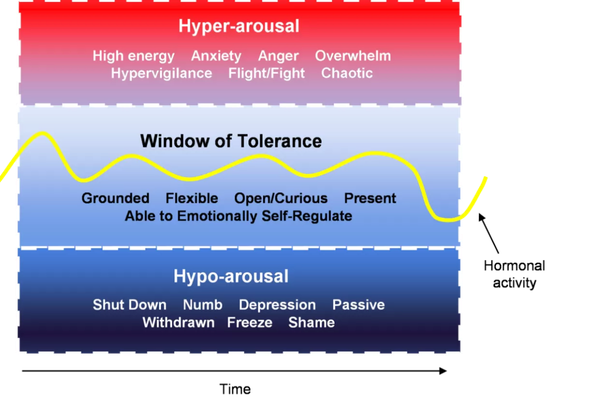
Window of Tolerance Source: Jade Emery
Ideally we can ride life’s daily ups and downs - like traffic or forgetting something in the grocery order - and stay within our window. This is represented by the yellow line, symbolizing hormone fluctuations like cortisol and adrenaline. Similarly, we can manage tough seasons of stress or grief without turning to unhealthy coping strategies. This actually takes practice and patience to master. Emotional regulation is an important maturity task we ideally accomplish in childhood with help from our parents or caregivers, and master by adulthood.
Being outside our window of tolerance can look different ways. Being “above” the window looks like flying off the handle or feeling a big, activating emotion like anger, stress or anxiety. This often results in yelling, screaming, racing heart, etc. Being above the window is considered under-regulation, and involves reacting extremely instead of responding from a calm, grounded place within our window.
“Below” the window is when we crash and fall into numbness, apathy or depression. We can temporarily collapse, or there can be a pattern of over-regulation where we suppress or lock down all emotions.
When we stuff or suppress emotion as a coping strategy we don’t only ignore the negative ones; all emotions get numbed out or buried. People who employ this coping strategy can look really well-put together and placid. But the cracks show when they don’t show much emotion at all, even when emotions would be appropriate.
The patterns of feeling/not feeling and expressing our emotions develop due to our nervous system’s reactivity into safety mode resulting in a fight, flight or freeze response.
So when you find yourself having a big reaction, get curious about it. Ask yourself, “What is this about? Why am I reacting this way?” This awareness begins to bring you back within your safe zone inside your window of tolerance. Going for a walk, talking with a trusted friend or family member are also good ways to calm your nervous system and reset.
Stress or Trauma
It’s important to note that stress can narrow our window of tolerance, so it may not take much to trigger a big reaction to something, pushing us out of our window. During busy or intense seasons of life, create margin to care for yourself by getting enough sleep, down time, practice healthy habits and receive support from friends. Remember, burning the candle at both ends, drinking or eating too much, etc. can be red flags that you are out of your window of tolerance and employing unhealthy coping mechanisms.
Another thing to note about the window of tolerance is that trauma can narrow our window in a more enduring way, making mastering emotional regulation more challenging. This is especially true if we experience trauma in childhood.
Trauma is generally thought of in two categories: “Big T” and “Little t”. Big T is easier to spot - a serious car accident, assault, or losing a parent as a child. Little t is a misnomer because it is often developmental. Like death by a thousand cuts, if you were chronically bullied, or had an insensitive parent that didn’t “get” you, this equally formed you and your nervous system as much as any Big T traumatic event. Some evidence suggests Little t trauma is more impactful because of the consistent nature of the harm, like a drip, drip of water creating damage and erosion over time.*
Identifying how narrow or broad your window of tolerance is is an important first step. Chances are, if you’re reading this, you’re experiencing life outside your window more often than you’d like. Or you may realize your window feels permanently narrow due to trauma.
The work of therapy is at the edges of your window. There will be discomfort, but the pace of therapy should feel manageable. Over time, you can learn skills to stay in your window of tolerance with less reactivity. There is hope! But it takes work, practice over time. Reach out today to see if I can help.
*For more on understanding trauma and emotional capacity check out The Body Keeps the Score by Bessel Van Der Volk, and works by psychiatrists Daniel Siegel and Curt Thompason who both write extensively about the body-mind connection.